5CO02 Assignment Example

The 5CO02 Evidence-based Practice in the CIPD Level 5 course focuses on applying evidence-based practice to strengthen decision-making within HR and L&D. It enables learners to gather and analyse both quantitative and qualitative data to address real workplace challenges. The module also explores critical thinking, ethical considerations and methods for evaluating the impact of people practices on organisational outcomes. Developing these competencies not only enhances academic performance but also equips learners to handle real-world HR issues effectively.
Table of Contents
Task one
Learning Outcome 1: Gain a deep understanding of strategies that support critical thinking and the use of evidence to improve decision-making.
AC 1.1 Evaluate the concept of evidence-based practice, including two examples of where Camellia’s People Team could use it to ensure sound decision-making in people practice.
Evidence-based practice (EBP) is a conscious and deliberate practice that involves using the ‘best available evidence’ informed by critical thinking, organisational data, staff perspectives, external research and professional experience to guide decisions rather than relying on assumption, tradition, opinion or “fads” (CIPD, 2025). For Camellia, it is about ensuring the people team make decisions based on solid data, sound judgement and not just their gut.
Strengths
EBP increases the trustworthiness and quality of decisions about people (CIPD, 2025). It minimises bias, promotes transparency and enables the People Team to deliver value to sceptical customers, including one SMT member who doubted the department’s analytical skills. Besides, it derives more balanced, defensible, results and contributes to the department’s credibility over time by triangulating multiple evidence sources (data, research, stakeholder views, professional judgement) (CIPD, 2025).
Limitations
EBP has its limitations, however. Good data is not always available, especially in a new People Team with an in-development system and analytical maturity, like Camellia’s. Additionally, numbers can be misinterpreted without appropriate expertise, and an overreliance on analysis can lead to a loss of context, culture or ethical context (CEBMa, 2024). Evidence collection and analysis also require time and resources that could be limited in the context of a fast-moving SMT.
Application to Camellia
People Team
Camellia would be able to leverage on structured interview scorecards, assessment results, and past retention and performance data tied to recruitment efforts to make objective decisions about which methods of recruitment are effective. This would ensure that they hire the right people, thereby creating a more cost-effective and sustainable organization (Rukadikar, Khandelwal & Warrier, 2025).
Reward
Data from pulse surveys and exit interviews, combined with benchmarking against market rates, enabled the team to demonstrate if reward is creating dissatisfaction or attrition (Singhal, 2025). This, then allowed them to act on the right offer at the right cost as opposed to offering a blanket pay increase.
Conclusion
In general, EBP provides Camellia’s People Team with a good structure to enhance decision quality and rebuild confidence in the SMT. However, the team needs to build data literacy and see evidence as one component of decision making, alongside professional judgement and the voice of stakeholders.
Struggling with Your CIPD?
Secure your future with our high-quality paper—order now!
You can talk to the writer using our messaging system and keep track of how your assignment is going.
Order Now WhatsAppAC 1.2 Evaluate one appropriate analysis tool and one appropriate analysis method that Camellia might apply to diagnose issues, challenges, and opportunities.
Analysis Method
The Force Field Analysis
The appropriate analysis tool for Camellia is the Force Field Analysis – developed by Lewin (1951). It gives a framework for determining the forces for or against a proposed change (Steele, 2025). This is applicable for Charlotte as she has to address the gaps in recruitment and selection, onboarding, reward, learning and development and the use of data by the People Team. For instance, some factors that might drive the improvement of evidence-based people practice include SMT expectations of better data use and employees’ desire to engage in people practice development. Limited analytical experience among the People Team, poor process, and lack of receptivity for moving away from any past practice, could be restraining forces.
Strengths and weaknesses
The most useful aspect of Force Field Analysis is that it would enable Charlotte to take a step back from identifying symptoms and think about the reasons an issue arises and what might help or hinder improvement. It can thus facilitate prioritisation and predict resistance before change is put in place (Keenan, 2024).
The tool may, however, oversimplify the organisational problems, and the allocation of the power of different forces can be subjective. It should therefore be backed up by evidence, not provide evidence in and of itself (Walker, 2023). Overall, it is appropriate as it offers a simple and systematic framework for the diagnosis of organisational challenges and opportunities for Charlotte.
Interviews – Analysis Method
The analysis method that is appropriate to use is a semi structured employee interview. Through this approach, Charlotte would be able to collect qualitative data on the experiences of their employees during the recruitment process, onboarding, reward and learning and development (Dunwoodie, Macaulay & Newman, 2022). For instance, it might ask staff about why they feel there are barriers in their ability to develop themselves, barriers to effective induction or how they perceive the fairness and effectiveness of reward systems.
Advantages and disadvantages
An advantage of interviewing is that one can glean depth and context that may be missed by numerical survey results (Dunwoodie, Macaulay & Newman, 2022). When employees explain their experiences, the reasons behind these experiences are also provided, and Charlotte is then able to look beyond the patterns in the data to discover the underlying reasons for the experiences. Moreover, semi-structured interviews are consistent in that the questions are similar for all, and the questions allow the participants to discuss unexpected issues (Juraeva, 2025).
However, interviews can be time consuming and expensive if numerous employees are being interviewed. Responses can also be affected by the concern for confidentiality and/or the social acceptability of the response (Juraeva, 2025). Charlotte should therefore use a representative sample, assure the participants the confidentiality of the information and analyse the responses in a systematic way to minimise bias.
Overall Evaluation
Overall, the use of Force Field Analysis is appropriate as it is a structured approach to gather information on what factors enable or constrain change, and semi-structured interviews are appropriate as they can be used to generate detailed employee evidence of the causal factors behind problems. Together they would enhance Camellia’s evidence-based practice by supporting structured analysis with employee knowledge; this will enable Charlotte to present more reliable and meaningful people-related evidence to the SMT.
AC 1.3 Explain to Camellia’s People Team the main principles of critical thinking, including how these might be applied at Camellia.
Understanding Critical Thinking
Critical thinking is a disciplined and objective process of assessing information and arguments to arrive at a conclusion instead of assuming. It is not criticism, it is an evaluation of ideas based on a rational, evidence-based process, including one’s own (CIPD, 2026).
Principles
Objective, Rational Thinking and Well-Reasoned Argument
This involves utilising objective language and thinking logically and reasonably about the subject matter. It is the principle of putting aside one’s feelings or their opinion to consider evidence in an objective way (The Foundation for Critical Thinking, 2019). In Camellia, critical thinking is when the People Team asks themselves if they should introduce a new induction programme because it seems like a good idea in their heads, but they do not do so without first checking it against the evidence (for example, new starter turnover data). The application of ideas to one’s own is to look out for evidence that might refute them, rather than evidence that confirms them, and it gives the team a greater credibility with the SMT.
Discussing and verifying sources
Critical thinkers question sources of information, its collection and its authenticity. There is a need to be aware of sample size and the proportion of respondents that have completed the pulse survey questionnaire, the wording of the questions and to be mindful of the conclusions drawn from the raw data collected, rather than assuming it is accurate and complete (The Foundation for Critical Thinking, 2019).
Awareness of personal agendas and misinformation
Persons and parties can only present information in a way that will affirm a certain point (Zwiers & Crawford, 2023). Where a member of an SMT suggests a particular reward change with vigour, the People Team should examine underlying interests or assumptions and request some form of evidence that supports the suggestion, as well as look at the process of change for consideration. This is true for challenging others’ ideas in a constructive way, as well as being aware of unverified statements or ‘fake news’ that is going around within the organisation.
Application at Camellia
If Camellia’s People Team use these principles consistently to their own thinking and to each other’s, then they can debate proposals rationally, without going into group-think, and make decisions based on well-scrutinised evidence and not on assumption or influence.
AC 1.4 Explain at least two decision-making processes that Camellia’s People Team could apply to ensure that effective outcomes are achieved.
Six Thinking Hats (De Bono)
This process organises group decision-making with an invitation to deliberately think about a problem from six different angles: Facts (white), Emotions (red), Caution/risks (black), Benefits (yellow), Creativity (green), Process control (blue) (The De Bono Group, 2019). Instead of considering a decision from one perspective there is a planned progression through each lens, minimising the likelihood of one dominant voice or emotional response influencing the decision.
Application to Camelia
The People Team may be able to use this approach in an SMT discussion when responding to the results of the pulse survey, as they consider how to respond: Consider the raw data objectively (white hat), acknowledge staff frustration (red hat), identify implementation risks (black hat), look at the benefits of proposed changes (yellow hat), and brainstorm creative solutions (green hat). This ensures that the eventual decision is balanced and not “reactive” as is the SMT’s concern with weaker data-informed decision making (The De Bono Group, 2019).
Problem-Outcome Frame
It is a process which redraws the picture of decision-making by first clearly stating what is the real problem and what is the desired outcome; only then, solutions are proposed, and teams do not rush into a solution based on the assumption (Binder & Watkins, 2024). It helps to differentiate between indicators and underlying issues.
Application to Camelia
When replacing staff in one department, for example, is known to be a problem, as indicated by exit interviews, the People Team should not immediately jump to the conclusion that pay is the issue with the department. On the other hand, a clear definition of the problem (for example, “attrition rate is highest for staff with less than 12 months of experience”) and desired outcome (example “decrease staff turnover early in the employment cycle by X%”) will ensure that further analysis (say on onboarding, management support, or rewards) focuses on the actual problem, not a convenient assumption.
Why they enhance outcomes
The two processes counteract bias and assumption driven decisions: Six Thinking Hats expands the view in group discussions and the problem-outcome frame provides clarity of purpose prior to action. They help Camellia in its journey towards becoming a more rigorous, evidence-based people decisions organisation.
AC 1.5 Assess how at least two different ethical perspectives could influence decision-making by the People Team at Camellia.
Utilitarian Perspective
The Utilitarian approach to ethics is based on the consequences of the decision – what is most beneficial for the most people (Sola, 2023). This is one of the perspectives that influences people practice as it helps decision makers think about the overall benefit of the organisation and its workforce as opposed to narrowly on individual cases.
Application to Camellia and Assessment
If the People Team is considering whether to restructure reward budgets, one way this might be achieved is to think about using limited resources to fund interventions that have a positive impact on the majority of staff members (for example, by adopting a new pulse survey system which is more satisfactory for most staff) rather than one that addresses the concerns of one individual. This assists in prioritising decisions that need to be made where resources are scarce, and helps to show impact to the SMT (McCombs School of Business, 2025). However, it can excuse the case of a minority or individual being harmed for the sake of the majority, with the danger of unfair treatment towards the smaller minority of employees, a quandary for Camellia given its people-centric, ethical brand.
Deontological (Duty-Based) Perspective
Deontological ethics make a judgement based on whether action is based on moral rules, duties or principles – irrespective of the outcome (Mohn, 2022). Rights and wrongs of action is in accordance with rules, which are fairness, honesty, legal compliance, among others and not in accordance with the consequences produced.
Deontological approach in recruitment and selection
In recruitment and selection, a deontological approach would force Camellia to uphold fair selection processes for all candidates, even if it is possible to find a faster or seemingly better way of hiring someone by using a shortcut, but it is not fair. This ensures legal compliance and organisational integrity, important in the context of Camellia’s aim of establishing trust in SMT. The shortcoming of its application is its rigidity: getting rigid and following rules blindly may lead them to miss the opportunity of judging flexibly within context and individual exceptional situations (Feess, Kerzenmacher & Timofeyev, 2022).
Comparative Assessment
Camellia is real for both points of view. Utilitarianism supports decisions that are pragmatic and based on the use of resources, and have a broad organisational benefit, while deontology helps ensure that individual treatment is based on the principles of fairness and consistency and is guided by the principle of duty. However, as a plant-based, ethically-driven brand, the People Team should not just be looking at consequences alone; decisions based on consequences and good procedural fairness will result in pragmatic and ethically sound decisions.
Learning Outcome 3 :Learn how to measure the impact of people-focused practices on an organization.
AC 3.1 Appraise one way that Camellia’s People Team could measure financial performance and one way that Camellia’s People Team could measure non-financial performance.
Financial measure
Return on Investment (ROI)
ROI is the percentage (or financial return) earned by a particular investment compared to the price of that investment (Phillips, 2023). ROI may be an indicator for Camellia’s People Team in terms of the financial return or cost of their L&D investments; for instance, if they are considering investing in a new training programme, they might look at how much productivity they can measure out of it, the cost of turnover, or the likely increase in sales.
Strengths and Limitations
ROI is a definite number that is easily understood and it is a good figure with which the SMT feel comfortable, as they make most business decisions in financial terms (Phillips, 2023). This would enable the People Team to clearly showcase value and make budget requests—this is what the SMT are concerned about when they feel that data credibility is low—and provides a hard, comparable metric they can do this on, which they can look back on in the future.
However, ROI calculations with people interventions can be difficult to measure, because for example it is challenging to statistically measure the financial effect of an onboarding redesign if there were other concurrent factors in the business (market, product launch, and others). It also has the potential to be overly simplistic and quantitative—such as culture or morale—by reducing it to simply financial, which might undervalue efforts that provide a benefit, but is not easily monetised (Phillips, Phillips & Toes, 2024).
Employee engagement
Employee engagement includes how emotionally committed and how much discretionary effort employees bring to their work and is typically collected using a survey like Camellia’s pulse survey (CIPD, 2024). It encompasses things such as intention to stay, advocacy and motivation.
Strengths and Weaknesses
Engagement data can provide a lot of information that a financial measure cannot, and it can help the People Team determine what is going on before a problem even becomes financial—such as a turnaround or drop in productivity. The measure is easily actionable, directly relevant to current priorities (such as onboarding and reward) and is something that Camellia already collects as part of its pulse survey (CIPD, 2024).
Nevertheless, responses are subjective, can be biased, may be due to survey fatigue or timing (surveying immediately following a challenging announcement). Also, whereas ROI can be easily translated into dollars and cents, engagement is not so easily equated to monetary value and may require some interpretation to justify a commitment of resources to an SMT that is only interested in the bottom line (CIPD, 2021).
Conclusion
Combined, ROI and employee engagement would offer complementary proof: money and a human perspective, which helps to reinforce Camellia’s people measurement strategy.
AC 3.2 Explain how recruitment and selection activities might add value at Camellia and two methods that might be used to measure the impact and value of these activities.
How Recruitment and Selection Add Value
Recruitment and selection can contribute to meeting business goals – improve productivity, innovation and customer experience by attracting and selecting candidates who possess the necessary skills, values and potential to achieve these goals (Ali et al., 2023). As a plant-based cosmetics company, employees who embody the go-goodness and sustainability goals of the company are key to Camellia’s success, and effective selection processes can help identify those who will represent the go-goodness and sustainability to customers and stakeholders.
Short term impact
In the short term there is a cost saving in recruitment time-to-hire and early attrition due to strong recruitment. It contributes to an organisation’s competitiveness and innovation in the long term by creating a work force (Aparna & Kumar, 2025). At the opposite end, poor recruitment has detrimental effects, including higher turnover costs, lower team morale, and/or potential product quality or customer trust issues due to values misalignment, so the impact of poor recruitment needs to be measured (Varkiani et al., 2025).
Measuring methods
Cost Benefit Analysis (CBA).
CBA is a process of weighing the expenses incurred in recruiting activity (advertising, agency fees, assessment time, onboarding) against the value produced (productivity, retention, and turn over costs) (Hayes, 2024). At Camellia, CBA could be used to determine whether there is value in investing in a more robust selection process based on values (such as structured interviews complemented by assessment centres) because of subsequent retention and performance benefits that will be felt by the SMT as a direct result of the recruitment spend.
Return on Investment (ROI)
ROI is a measurement of the amount of money one will make back for every finance they invest in recruiting, as a percentage (Beattie, 2025). Camellia’s People Team might be able to measure ROI by recording the expense of a recruitment campaign, and then measuring its impact on new-hire performance ratings, first-year employee retention, or sales figures that can be correlated with new hires. This will offer a measurable metric of the commercial value of the recruitment function, which should help the People Team gain credibility with the SMT after the complaints about lack of data being used to inform decisions.
Conclusion
Combining the two, CBA and ROI would enable Camellia to shift away from subjective assessments of recruitment and selection quality and towards impactful analysis, explaining how investment in recruitment and selection leads to real business value – the analytical rigour the SMT expects in the future.
Learning Outcome 2: Recognize the importance of ethical decision-making and develop ways to address challenges in people management within the workplace.
Task Two
AC 2.1 When you look at the spreadsheet, you see that 46 employees have responded to the survey. The survey contains nine statements and employees have indicated the extent to which they agree with each statement, using a five-point Likert scale. The spreadsheet shows how many employees selected each option. For example, five employees stated that they strongly agree with the statement, ‘My line manager discusses my development opportunities with me’.
You decide to calculate the percentage of employees who selected each option for each statement. Then you need to calculate a mean score for each statement by multiplying the number of responses at each scale point by that point’s value (1–5), adding the results, and dividing by the total number of respondents. For the mean scores, please round up or down to the nearest whole number.
| Survey Statement | Strongly Agree 5 | Agree 4 | Neither 3 | Disagree 2 | Strongly Disagree 1 | Mean |
| My line manager discusses my development opportunities with me. | 10.9% | 30.4% | 8.7% | 23.9% | 26.1% | 3 |
| I’m provided with every opportunity to develop my skills in my department. | 37.0% | 6.5% | 4.3% | 34.8% | 17.4% | 3 |
| I’m fully motivated in my job. | 65.2% | 2.2% | 0.0% | 2.2% | 30.4% | 4 |
| I’m given the opportunity to enhance my career at Camellia. | 45.7% | 0.0% | 17.4% | 32.6% | 4.3% | 4 |
| I’d welcome the opportunity to develop my workplace knowledge and skills. | 89.1% | 0.0% | 0.0% | 10.9% | 0.0% | 5 |
| I’m aware of training and development events that I can undertake in my role. | 45.7% | 4.3% | 28.3% | 21.7% | 0.0% | 4 |
| My performance review supports learning and development. | 34.8% | 6.5% | 0.0% | 45.7% | 13.0% | 3 |
| My goals and targets are clear within my workplace role. | 8.7% | 6.5% | 76.1% | 6.5% | 2.2% | 3 |
| My learning and development needs are identified by my manager. | 10.9% | 13.0% | 10.9% | 63.0% | 2.2% | 3 |
AC 2.2 Present your findings for Charlotte, using two different chart formats, one chart showing the mean scores and one chart showing the survey responses as percentages. Below each chart, ensure you include a written interpretation of what the chart shows.
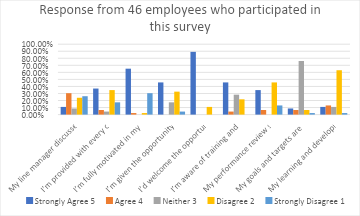
There is a considerable range in the experiences of employees’ learning and development at Camellia as evidenced from the mean score chart. The mean score for the statement, “I would welcome the opportunity to develop my workplace knowledge and skills,” is the highest at 5. The result is especially encouraging as it shows a very high level of interest from staff in learning and development. Both “fully motivated at work” and “opportunities to develop career” statements have relatively high mean scores of 4.
The lower average scores, however, show a lack of development support in the way things are done at present. The mean score for items regarding line-manager discussions about development opportunities, performance reviews supporting learning and development, clarity of goals and targets and managers identifying employees’ learning and development needs is 3. While these scores are not reflective of an overall level of dissatisfaction, they do indicate that staff feel that they are not always adequately supported by the processes and procedures of the organisation or by their managers. The overall pattern thus suggests gaps between the desire for development and the effectiveness of the systems and management practices to support the development.
Chart 2
Interpretation of the Percentage Response Chart
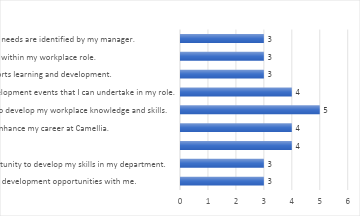
The Percentage Chart offers more detail by showing the distribution of responses by the five-point Likert scale. The most encouraging outcome is for employees’ willingness to build knowledge and skills at work which 89.1% strongly agreed. This supports the mean score of 5 and highlights Camellia as having significant opportunities to improve employee motivation to learn. Positive answers to the other questions on the chart are also high when it comes to motivation, as 65.2% strongly agree they are fully motivated in their job. Also, 45.7% strongly agree that they have opportunities to develop their careers at Camellia. The results indicate that there is a potential positive base for the organisation to build its L&D strategy.
However, the percentage responses suggest some noteworthy concerns that may only be partially masked by the mean scores. For instance, 63.0% do not agree that their manager identifies their learning and development needs, 45.7% do not agree and 13.0% strongly disagree that their performance review helps them in their learning and development. Likewise, half of those surveyed either do not agree or strongly disagree that their line manager discusses development opportunities with them.
AC 2.3 Based on what you discovered when analysing the survey results, make at least three recommendations to improve learning and development at Camellia. Recommendations must be justified and include benefits, risks and financial implications.
Employees at Camellia desire learning and development, but this is not always reflected in effective learning and development activities. This was the highest score with 89.1% strongly agreeing that they would want to build their knowledge and skills at work, with a mean score of 5. However, it is essential that there are weaknesses in management support and the link between performance management and development needs to be addressed. Based on these themes, three recommendations are proposed.
- Introduce structured conversations and individual development plans (IDPs) for development.
Camellia should be asking managers to regularly discuss development with staff, and document agreed learning goals on individual development plans. There is strong support for this recommendation, as only 10.9% strongly agree their line manager discusses development opportunities with them whilst 50.0% disagree or strongly disagree with this statement, giving a mean of only 3. More importantly, 63.0 % of the respondents are bothered that their manager identifies their learning and development needs. This implies that development is not being identified systematically at line-management level.
The benefit of the recommendation would be to better match the aspirations of employees and the need of the organisation for the skills of employees, alongside to better engage the employees and develop their careers (Arnaud & Cahill, 2024).
One potential challenge is that managers could see development discussions as an extra administrative load, which could lead to discrepancies in implementation. The financial cost should be relatively low, if current performance-management systems are modified to incorporate IDPs (Arnaud & Cahill, 2024).
Financial implications
The costs would largely be the training of the managers and some time to discuss these matters regularly, making it a relatively cheap intervention (OPM, 2018).
- Strengthen managers’ capability to support learning and development.
Camellia should provide managers with practical training in identifying development needs, providing developmental feedback, coaching employees and relating performance discussions to relevant learning interventions. The results of the survey indicate that the area is quite weak with 45.7 % rating the performance review as rated as a 3 or below (disagree or strongly disagree), and 13.0 % rating the performance review as a 2 or below (disagree or strongly disagree). This is in contrast to the 89.1% who strongly agree they would want development opportunities, which shows a disconnect between employee needs and management efforts.
The benefit would be better quality conversations about development and more focus on performance reviews to fill skill gaps. It could also improve employee satisfaction since the employees would have more direction for their development (CIPD, 2025).
Failure to ensure that training managers are held to account by senior leaders to ensure that the training is followed up to change behaviour is the risk (Andriotis, 2018).
Financial considerations would relate to external/internal management-development training costs and managers’ time out of their normal assignments (Andriotis, 2018). However, the use of internal facilitators and short workshops may help to limit costs.
Create a more visible & usable L&D programme.
Camellia should develop a learning hub or L&D calendar centrally that includes training and development opportunities and pathways, and career opportunities. However, access to information is not consistent as 28.3% do not respond with certainty, 21.7% disagree, while 45.7% strongly agree that they are aware of training and development events. This is especially relevant given that the employees are highly interested in development, with 89.1% strongly agreeing that they would like opportunities to grow in their knowledge and skills in the workplace.
The advantage would be enhanced awareness of, and involvement in learning, alongside career development and in-house progression. The downside is that if staff has to leave their jobs to go on training, there may be budget and staffing pressures due to this increased participation (CIPD, 2025).
Financially, Camellia would have to buy resources that will be appropriate for learning, but there are many activities that could be provided using their existing internal knowledge, web-based learning, and low-cost resources (Hayden, 2023). Participation and outcomes should be tracked to ensure value for money is gained from spending.
References
Ali et al., A. (2023). Exploring the impact of recruitment and selection on organizational performance. ResearchGate, [online] 12(3), pp.205–215. Available at: https://www.researchgate.net/publication/374297422_Exploring_the_Impact_of_Recruitment_and_Selection_on_Organizational_Performance [Accessed 19 Aug. 2026].
Andriotis, N. (2018). Why you should always involve managers in employee training and development. [online] eLearning Industry. eLearning Industry. Available at: https://elearningindustry.com/role-of-manager-in-employee-development-benefits [Accessed 19 Aug. 2026].
Aparna, S.M. and Kumar, S. (2025). Changing landscapes in recruitment: A critical analysis of past, present and future. Personnel Review. doi:10.1108/pr-01-2024-0098.
Arnaud, E. and Cahill, S. (2024). Graduate student perceptions of the effectiveness of individual development plans. Canadian journal of higher education, [online] 54(1), pp.71–88. doi:10.47678/cjhe.v54i1.189931.
Beattie, A. (2025). ROI: Return on investment meaning and calculation formulas. Investopedia. Available at: https://www.investopedia.com/articles/basics/10/guide-to-calculating-roi.asp [Accessed 19 Aug. 2026].
Binder, J. and Watkins, M.D. (2024). To solve a tough problem, reframe it. [online] Harvard Business Review. Available at: https://hbr.org/2024/01/to-solve-a-tough-problem-reframe-it [Accessed 19 Aug. 2026].
CEBMa (2024). What are the limitations of evidence based practice? » CEBMa. [online] cebma.org. Available at: https://cebma.org/resources/frequently-asked-questions/what-are-the-limitations-of-evidence-based-practice/ [Accessed 19 Aug. 2026].
CIPD (2021). CIPD | employee engagement: An evidence review. [online] CIPD. Available at: https://www.cipd.org/en/knowledge/evidence-reviews/evidence-engagement/ [Accessed 19 Aug. 2026].
CIPD (2024). CIPD | employee engagement & motivation | factsheets. [online] CIPD. Available at: https://www.cipd.org/en/knowledge/factsheets/engagement-factsheet/ [Accessed 19 Aug. 2026].
CIPD (2025a). CIPD | analysis | how L&D can create value: Role of the line manager in supporting skills development. [online] CIPD. Available at: https://www.cipd.org/en/views-and-insights/thought-leadership/insight/learning-value-role-manager/ [Accessed 19 Aug. 2026].
CIPD (2025b). CIPD | evidence-based practice for effective decision-making | factsheets. [online] CIPD. Available at: https://www.cipd.org/en/knowledge/factsheets/evidence-based-practice-factsheet/ [Accessed 19 Aug. 2026].
CIPD (2025c). CIPD | learning and development for people professionals. [online] CIPD. Available at: https://www.cipd.org/en/knowledge/guides/learning-and-development/ [Accessed 19 Aug. 2026].
CIPD (2025d). Evidence-based HR: Make better decisions and step up your influence. [online] CIPD. Available at: https://www.cipd.org/en/knowledge/guides/evidence-based-profession/ [Accessed 19 Aug. 2026].
CIPD (2026). Critical thinking masterclass for CIPD students. [online] CIPD. Available at: https://www.cipd.org/uk/get-involved/events/2026/5/critical-thinking-masterclass-for-cipd-students/ [Accessed 19 Aug. 2026].
Dunwoodie, K., Macaulay, L. and Newman, A. (2022). Qualitative interviewing in the field of work and organisational psychology: Benefits, challenges and guidelines for researchers and reviewers. Applied Psychology, [online] 72(2), pp.863–889. doi:https://doi.org/10.1111/apps.12414.
Feess, E., Kerzenmacher, F. and Timofeyev, Y. (2022). Utilitarian or deontological models of moral behavior – what predicts morally questionable decisions? European Economic Review, 149(1), p.104264. doi:10.1016/j.euroecorev.2022.104264.
Hayden, D. (2023). CIPD | learning evaluation, impact and transfer. [online] CIPD. Available at: https://www.cipd.org/en/knowledge/factsheets/evaluating-learning-factsheet/ [Accessed 19 Aug. 2026].
Hayes, A. (2024). Cost-benefit analysis: How it’s used, pros and cons. [online] Investopedia. Available at: https://www.investopedia.com/terms/c/cost-benefitanalysis.asp [Accessed 19 Aug. 2026].
Juraeva, M. (2025). Advantages and disadvantages of the structured interview method. American Journal of Philological Sciences, 5(11), pp.343–345. doi:10.37547/ajps/volume05issue11-79.
Keenan, M. (2024). Force-field analysis | EBSCO. [online] EBSCO Information Services, Inc. | www.ebsco.com. Available at: https://www.ebsco.com/research-starters/social-sciences-and-humanities/force-field-analysis [Accessed 19 Aug. 2026].
McCombs School of Business (2025). Utilitarianism. [online] Ethics Unwrapped. The University of Texas at Austin. Available at: https://ethicsunwrapped.utexas.edu/glossary/utilitarianism [Accessed 19 Aug. 2026].
Mohn, E. (2022). Deontological ethics. [online] EBSCO Information Services, Inc. | www.ebsco.com. Available at: https://www.ebsco.com/research-starters/religion-and-philosophy/deontological-ethics [Accessed 19 Aug. 2026].
OPM (2018). Career development. [online] U.S. Office of Personnel Management. Available at: https://www.opm.gov/policy-data-oversight/training-and-development/career-development/ [Accessed 19 Aug. 2026].
Phillips, P.P. (2026). Return on investment (ROI) basics. [online] Google Books. Available at: https://books.google.co.ke/books?hl=en&lr=&id=v7zLEAAAQBAJ&oi=fnd&pg=PP1&dq=Return+on+Investment+(ROI)&ots=dWBRvy8jSg&sig=FgJHM6r8AFsuH9jS38Y5CAfu5EE&redir_esc=y#v=onepage&q=Return%20on%20Investment%20(ROI)&f=false [Accessed 19 Aug. 2026].
Phillips, P.P., Phillips, J.J. and Toes, K. (2026). Return on investment in training and performance improvement programs. [online] Google Books. Available at: https://books.google.co.ke/books?hl=en&lr=&id=bVYIEQAAQBAJ&oi=fnd&pg=PP1&dq=Return+on+Investment+(ROI)&ots=S1uRTHrGJo&sig=JzRfZF6AJaip_9wkWUYJx9EJy64&redir_esc=y#v=onepage&q&f=false [Accessed 19 Aug. 2026].
Rukadikar, A., Khandelwal, K. and Warrier, U. (2025). Reimagining recruitment: Traditional methods meet AI interventions- A 20-year assessment (2003–2023). Cogent Business & Management, 12(1). doi:10.1080/23311975.2025.2454319.
Singhal, D. (2025). Top 20 hR metrics to drive smarter decisions in 2025. [online] CHRMP. Available at: https://www.chrmp.com/top-20-hr-metrics/ [Accessed 19 Aug. 2026].
Sola, A. (2023). Utilitarianism and consequentialist ethics: Framing the greater good. Ethics and Pandemics, pp.61–83. doi:10.1007/978-3-031-33207-4_4.
Steele, A. (2025). Force field analysis – the decision lab. [online] The Decision Lab. Available at: https://thedecisionlab.com/reference-guide/organizational-behavior/force-field-analysis [Accessed 19 Aug. 2026].
The De Bono Group (2019). Six thinking hats. [online] The De Bono Group. The De Bono Group. Available at: https://www.debonogroup.com/services/core-programs/six-thinking-hats/ [Accessed 19 Aug. 2026].
The Foundation for Critical Thinking (2019). Defining critical thinking. [online] The Foundation for Critical Thinking. Foundation for Critical Thinking. Available at: https://www.criticalthinking.org/pages/defining-critical-thinking/766 [Accessed 19 Aug. 2026].
Varkiani et al., S.M. (2025). Predicting employee attrition and explaining its determinants. Expert Systems with Applications, 272(126575), pp.126575–126575. doi:10.1016/j.eswa.2025.126575.
Walker, K.D. (2023). Force-field analysis. Springer Texts in Education, pp.197–201. doi:10.1007/978-3-031-04394-9_32.
Zwiers, J. and Crawford, M. (2023). Academic conversations. [online] Google Books. Available at: https://books.google.co.ke/books?hl=en&lr=&id=ax3cEAAAQBAJ&oi=fnd&pg=PT5&dq=critical+thinking&ots=l9Ng6gEFJe&sig=-rGj70zrDStpjRZMHJHapaQyQ_4&redir_esc=y#v=onepage&q&f=false [Accessed 19 Aug. 2026].
Related Articles: